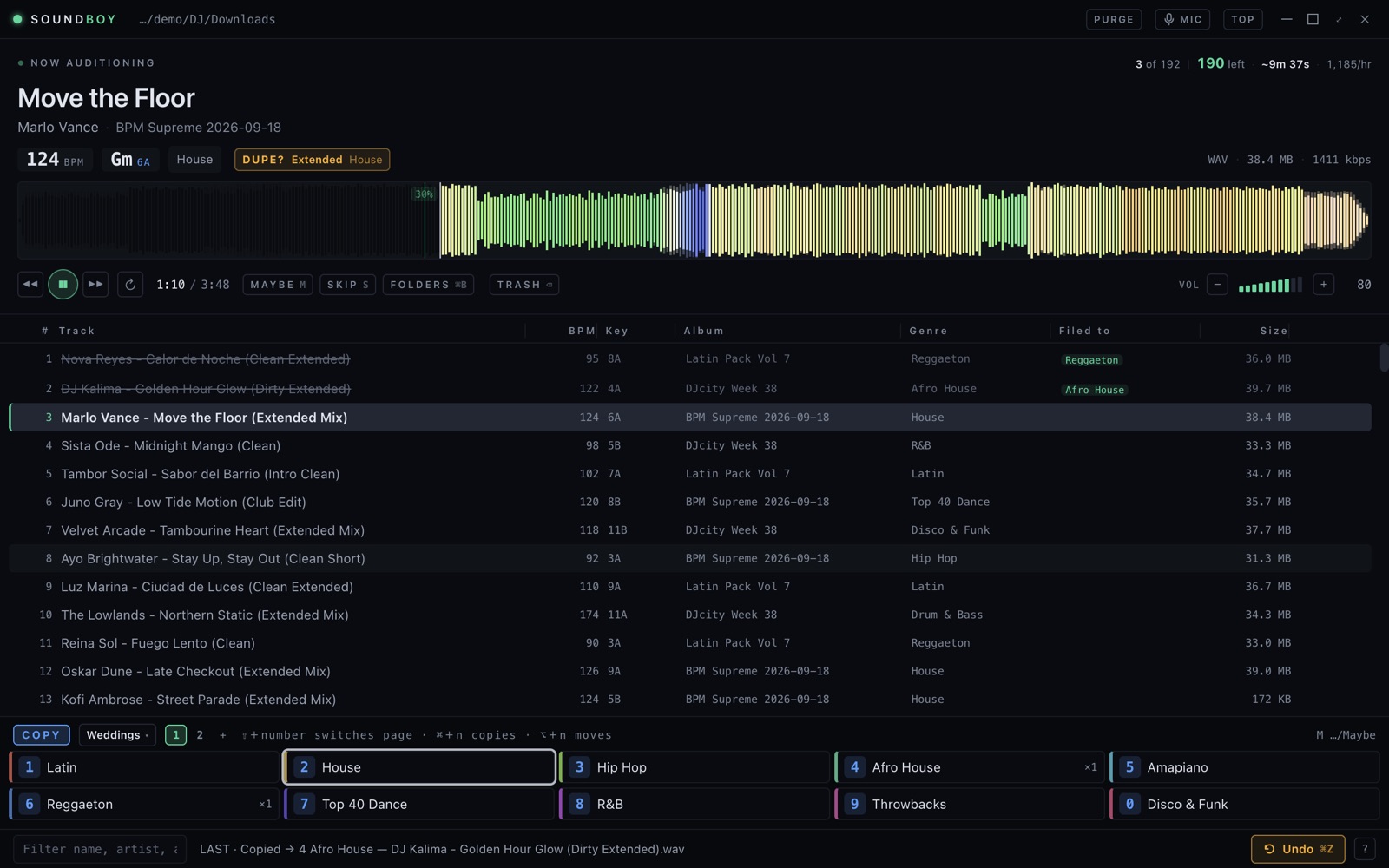
One job: get a heap of new downloads heard and into the right folders as fast as you can decide. Every feature below makes that faster, safer, or possible from somewhere other than the laptop.
Hear it, file it, next. A track plays, you press a key, and the next one is already loaded.
Every track starts 30% in, because intros tell you nothing. Skip the breakdown checks that point, and moves it when it would land in a quiet section.
It's read, and its waveform drawn, while you listen to the current one. Pressing a key moves you straight on.
Coloured by frequency, warm for bass and cool for treble, so you can see the drop coming. Click or tap it to jump there.
Read from the tags, decimals kept. The key shows in both notations, like F♯m 11A, whichever one the tag used.
MP3, WAV, AIFF, FLAC, M4A and AAC. A file that won't preview stays in the queue and can still be filed.
Press C. When a track ends, the next plays from its start, and nothing is filed for you. Scrubbing to the end doesn't count as ending.
Tracks sorted, seconds each, tracks per hour and time left. The pace is a median, so a coffee break doesn't wreck it.
It watches the folder. Tracks join in the order they arrived, and a download still in progress waits until it's finished.
Ten keys, six pages, and a separate setup for each kind of gig. Nothing is overwritten, and every move can be undone.
1–0 file into ten folders. Press a key that has no folder yet and it asks you to pick one.
Sixty folders in one setup. ⇧1–⇧6 switch pages, and the number keys follow.
A wedding setup and a club setup, each with its own folders. ⌘P swaps the whole layout. Duplicate a profile to start the next one.
Pick one in Settings. Hold ⌘ to copy or ⌥ to move just this track.
M sends a track to your Maybe folder. ⌫ moves it to a Soundboy Trash folder you can open. Nothing is ever deleted.
⌘Z puts the file back where it was, up to fifty steps back, and redo works too. If something else has taken the name since, it stops rather than overwrite it.
Same name, different file: it's saved as Track (2) and you're told. Same name and same size: it asks first. A move to another drive is checked before the original is removed.
If a copy of the song is already in a folder, or that genre usually goes there, the folder's key glows. ⏎ files it there.
⇧7 puts your ten most-used folders on the number keys, busiest first.
⌘B shows every folder in your library, not only the ones on keys. Search it, then file into any of them.
A stuttered keypress can't file the next track before you've heard it.
Each filing goes into a daily log on your own disk, with where every file went.
Pools resend tracks you bought last year, and four versions of the one you wanted. It catches both before they cost you an audition.
When a crate lands, it says how many tracks you already have and which came in more than one version, before the first track plays.
A match shows which folder already has your copy. Click it to see that file. It's a warning only, and never stops you.
It reads the version from the filename, and says nothing when two cuts really are different.
Tracks that are byte-for-byte copies of files you've already filed are offered as one sweep to the trash. There's nothing to listen to.
S skips without deciding. The count stays on screen, and ⇧S takes you back through them.
The last track ends on a summary: what was filed, skipped and trashed, and how many went into each folder.
For a folder that's already sorted but has grown too big. Nothing gets filed: each track is kept where it is, or purged.
K keeps a track, ⌫ purges it to the Soundboy Trash, and ⌘Z undoes either. ⇧P turns Purge mode on for the folder you're in.
On the phone, swipe the track right to keep it or left to purge it. The Keep and Purge buttons do the same.
Kept tracks are remembered for each folder, so the next pass only plays ones you haven't decided on. Start over plays them all again.
Say where a track goes, from across the room. It listens for a short list of commands and ignores everything else, lyrics included.
“Three.” “File Latin.” “Trash it.” “Maybe.” “Next.” “Undo.” “Back thirty.” And in Purge mode, “keep” and “purge”.
A command only counts when it's short, said on its own, and the only command in what you said. A chorus with “trash” in it does nothing.
A second command right after the first is held back, so “three… three” files one track, not the next one too. “Undo” always goes through.
The screen shows what it heard and what it did. A list keeps the last twenty-five, including near misses and why each did nothing.
Choose whether voice mode uses your AirPods or the phone's own mic, depending on whether full-quality music or being heard from across the room matters more.
Tap the mic on the watch and say one command. The same rules apply as everywhere else.
Your files live in the folders. These features copy your sorting into the apps you play from.
A Soundboy crate with a sub-crate for each folder, written into Serato's own crate files. Crates you made yourself are left alone.
A collection XML with a playlist for each folder. Point rekordbox's Imported Library setting at it once.
A playlist for each folder. Importing it again updates it in place and keeps your cue points.
An .m3u8 for each folder, which any DJ app can import.
Optionally writes the folder name into each MP3's Grouping tag. Audio and artwork are untouched, and undo takes the tag back out.
The keyboard does everything. So can your phone, a Stream Deck, a MIDI pad or your watch.
Turn it on in Settings and scan the code. Your phone's browser becomes the whole control surface, over your own Wi-Fi and not the internet.
Sorting, Browsing and Monitor, one button to switch. The ten keys are laid out like a Mac's number row.
Search all your folders and file into any of them. Hold one to put it on a number key.
Put Tailscale on the Mac and the phone, open the phone page at the Mac's Tailscale address, and it works from anywhere. The Mac just has to be awake.
Keys show the playing track, the folder behind each slot and your pace. They always file into the same folder, whatever page you're on.
F13–F21 file, trash, skip and undo from anywhere, for a macro pad or Keyboard Maestro. They aren't on a normal keyboard, so no other app loses a shortcut.
Press a pad, pick what it does, done. A $60 Akai LPD8 becomes a filing console. The same pads work in every profile.
A slim window that floats over Finder. Two looks: Deck, built to read at a glance at 1am, and Nineties.
An app with two modes: Remote drives the Mac, and Cloud sorts a Dropbox with no Mac at all. It's in private beta on TestFlight.
The Mac's whole remote in an app, with a strip on top showing whether it can reach the Mac and what's playing.
Sorts your Dropbox right on the phone, with the Mac asleep or no Mac at all. Dropbox moves the files on its own servers, so nothing downloads to file it.
Up to six pages of ten pads. Copy the Mac's pages in one tap instead of choosing sixty folders again.
Search, with pinned and recent folders, and make a new folder right there. Tick several and they all become pads.
The folders you sort often stay one tap away. Switch between them without leaving the deck.
If a folder already has that track: keep both, replace it, skip it or decide later. Undo brings back a copy you replaced.
What's playing, play and pause, trash, undo, Keep and Purge in Purge mode, and every folder in one list. The Digital Crown sets the Mac's volume. In Cloud mode the watch controls the phone.
A complication shows how many tracks are left to sort.
Point Soundboy at your Dropbox instead of a folder. Your tracks never have to download to the computer.
Dropbox moves the file on its own servers, so a 60 MB WAV files as fast as an MP3.
A track downloads when you play it. Tags are read from the first part of the file only.
Connecting Dropbox leaves your Mac's own setup alone. Switch back and everything is where you left it.
You sign in on Dropbox's own page, never in the app. The sign-in is kept in your keychain, and you can revoke it at dropbox.com any time.
No sign-up, no analytics and no crash reporting. What you sorted stays on your computer.
Your key is checked on your own computer, so a venue with no Wi-Fi can't lock you out. It's never checked while you're filing.
Opens with a double-click and no warnings. New versions download quietly and install when you quit.
A plain text file you can read first and decide whether to send. Nothing is sent without you.
The desktop app does everything. The other columns show what you can do from each remote.
| Feature | Mac | Windows | Phone page | iPhone app | Watch |
|---|---|---|---|---|---|
| Audition: waveform, BPM, key | Yes | Yes | Yes | Yes | Title and waveform |
| Ten keys, six pages | Yes | Yes | Yes | Yes | Every folder, one list |
| Maybe, Trash, Undo | Yes | Yes | Yes | Yes | Yes |
| Profiles, folder shelf | Yes | Yes | Folders | Crates shelf | No |
| Purge mode | Yes | Yes | Yes | Yes, with swipe | Keep and Purge |
| Continuous play | Yes | Yes | Yes | Yes | No |
| Voice mode | Yes | No | No | Yes | Tap to speak |
| Duplicate warnings | Yes | Yes | Yes | Yes | Yes |
| Serato, rekordbox, Traktor, M3U | Yes | Yes | Done on the Mac | No | No |
| Dropbox without syncing | Yes | Yes | Done on the Mac | Yes, no Mac needed | Through the phone |
| Stream Deck, MIDI, F13–F21 | Yes | MIDI and F-keys | — | — | — |